


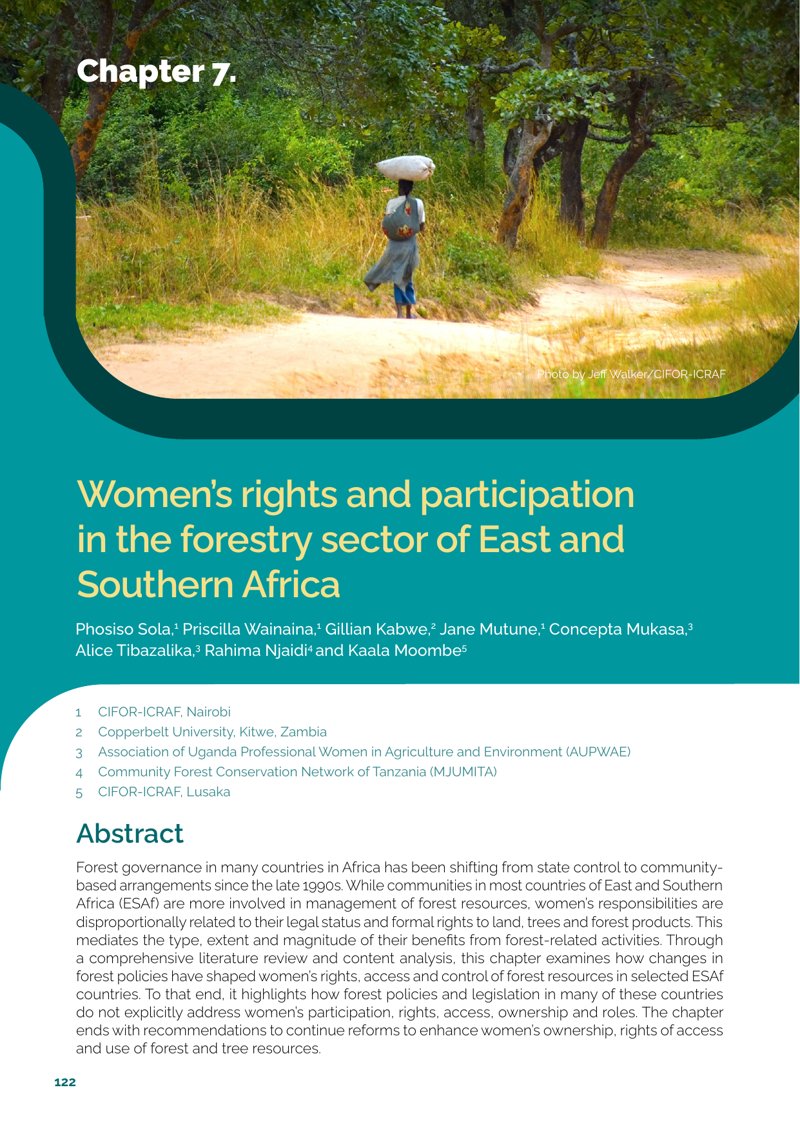
Forest governance in many countries in Africa has been shifting from state control to communitybased arrangements since the late 1990s. While communities in most countries of East and Southern Africa (ESAf) are more involved in management of forest resources, women’s responsibilities are disproportionally related to their legal status and formal rights to land, trees and forest products. This mediates the type, extent and magnitude of their benefits from forest-related activities. Through a comprehensive literature review and content analysis, this chapter examines how changes in forest policies have shaped women’s rights, access and control of forest resources in selected ESAf countries. To that end, it highlights how forest policies and legislation in many of these countries do not explicitly address women’s participation, rights, access, ownership and roles. The chapter ends with recommendations to continue reforms to enhance women’s ownership, rights of access and use of forest and tree resources.
This work is licensed under CC-BY 4.0
This work is licensed under CC-BY 4.0
Export citation:
RIS (.ris)
Endnote (.ciw)
Publication year
2026
Authors
Sola, P.; Wainaina, P.; Kabwe, G.; Mutune, J.; Mukasa, C.; Tibazalika, A.; Njaidi, R.; Moombe, K.
Language
English
Keywords
community forestry, equity, forest management, forest policy, gender, governance, land tenure, natural resources, women
Source
State of the Forests 2025: The Forests of the East and Southern Africa. CIFOR-ICRAF: Bogor, Indonesia and Nairobi, KenyaGeographic
Kenya, Uganda, Tanzania, Ethiopia, Mozambique, Zambia


