


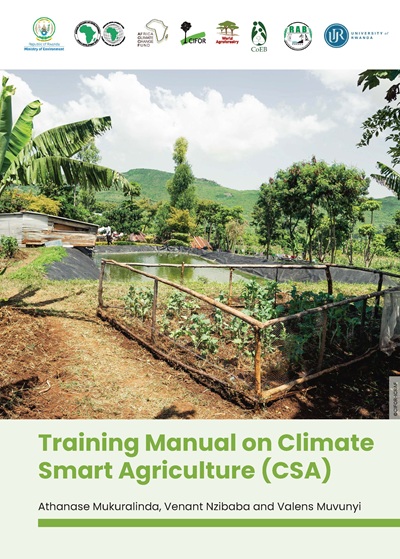
Rwanda’s agriculture sector is the largest contributor to national greenhouse gas emissions, accounting for 45.6% of the total, while the majority of the population depends on subsistence farming on increasingly degraded land. Climate change impacts—such as rising temperatures, erratic rainfall and prolonged droughts—pose growing risks, particularly in the eastern and southeastern regions. In response, the Government of Rwanda and its partners have prioritized climate-smart agriculture (CSA) as a pathway to enhance climate resilience, reduce emissions, and support sustainable development in line with the Paris Agreement. This manual aims to strengthen the capacity of extension agents and farmers by promoting CSA practices that integrate climate-resilient crop and livestock systems, improve agricultural productivity, enhance biodiversity through a gender-responsive agroecological approach, and support the development and implementation of effective climate adaptation and mitigation strategies.
This work is licensed under CC-BY 4.0
This work is licensed under CC-BY 4.0
Export citation:
RIS (.ris)
Endnote (.ciw)
Publisher
CIFOR-ICRAF: Bogor, Indonesia and Nairobi, Kenya
Publication year
2026
Authors
Mukuralinda, A.; Nzibaba, V.; Muvunyi, V.
Language
English
Keywords
capacity building, climate change adaptation, climate change mitigation, climate smart agriculture, crop production, farming systems, greenhouse gas emissions, land degradation, livestock, resilience, sustainable agriculture
Geographic
Rwanda


