


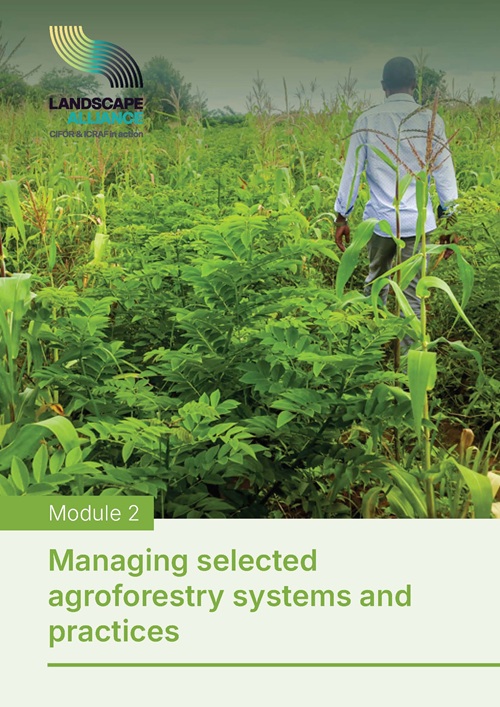
Agroforestry provides an integrated land management strategy that brings together trees, crops, and sometimes livestock to improve productivity, strengthen ecological resilience, and support long-term sustainability. This module introduces participants to key and selected agroforestry systems and the principles that guide their effective management, including species selection, spatial arrangement, soil fertility improvement and conservation-oriented practices. By exploring and practicing the tree management skills under diverse agroecological zones, participants will gain the knowledge and skills needed to optimize tree–crop interactions, improve land productivity and support climate-resilient agriculture. Additionally, the module draws attention to agroforestry’s role in reducing land degradation, enhancing biodiversity, as well as strengthening the livelihoods of smallholder farming households.
This work is licensed under CC-BY 4.0
This work is licensed under CC-BY 4.0
Export citation:
RIS (.ris)
Endnote (.ciw)
Publisher
CIFOR and ICRAF as Landscape Alliance: Bogor, Indonesia and Nairobi, Kenya
Publication year
2026
Authors
Chikwense, K.; Njoloma, J.; Chikuta, C.; Nyoka, I.; Haswell, C.; Udaya Sekhar, N.; Tesfai, M.
Language
English
Keywords
agroecology, agroforestry, agroforestry system, conservation, land management, livelihoods, natural regeneration, seed production, soil fertility, sustainable agriculture, tree planting
Geographic
Malawi


