


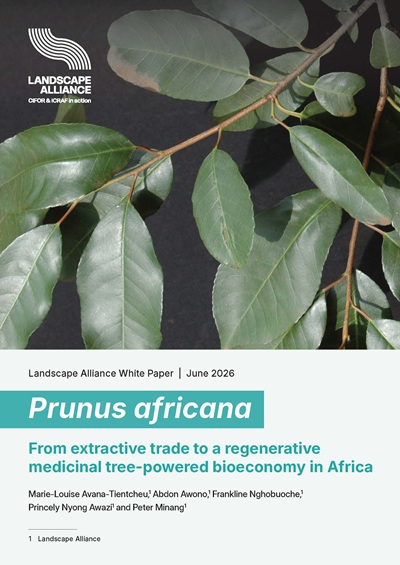
- Prunus africana (African cherry) is a highly valuable medicinal tree species distributed across more than 22 African countries where it provides a wide variety of ecosystem services including biodiversity conservation, watershed protection, carbon sequestration in montane forest ecosystems, as well as many products of socioeconomic interest collected from its bark, roots, wood and leaves.
- The anti-inflammatory and anti-androgenic properties of its bark extract are used in traditional and conventional medicine for treating benign prostatic hyperplasia (BPH), prostate cancer and other urinary ailments affecting older men worldwide. Moreover, recent advances in phytochemistry have revealed novel bioactive fractions with potential applications in gastrointestinal oncology, dermatological regeneration, cosmeceuticals and functional food preservatives, thereby broadening opportunities for P. africana-based biopharmaceutical development.
- Europe remains the largest importer of P. africana bark products, while Asia is rapidly expanding its pharmaceutical and herbal integration markets. North America maintains stable demand through supplements and over-the-counter prostate formulations. African markets for P. africana based-medicinal and pharmaceutical products remain very poorly developed.
- To align with the African Union strategy for driving circular nature-based industrialization, some African countries, including South Africa, Ghana, Nigeria, Cameroon, Uganda and Kenya are promoting medicinal herbal-based bioeconomy frameworks and biopharmaceutical companies. Such developments are expected to catalyse the African perspectives on a P. africana powered bioeconomy.
- The global market for P. africana products is projected to grow from USD 150 million in 2024 to USD 250 million by 2033, driven by rising demand for herbal medicines and aging populations. The projected innovations in its medicinal applications will certainly add to the current growing trend.
- Due to international trade regulations imposed by the inclusion of the species under CITES Appendix II since 1995, Cameroon has contributed to the development of sustainability measures through institutionalization of Non-Detriment Findings (NDFs), supported by scientific evidence on improved bark harvesting techniques and standards, existing harvestable tree potential, and inclusive management plans. Moreover, domestication and integration into agroforestry, restoration and climate agendas, offer an opportunity to move from a compliance-driven model to a genuinely regenerative bioeconomy.
- The trend in global dry bark exports shows distinct phases tied to trade traffic and regulations as well as CITES quota realignments, with Rwanda, Cameroon, Tanzania, Democratic Republic of the Congo (DRC) and Burundi supporting nearly 90 percent of the global bark export market.
- Despite persistent challenges, including weak governance, inequitable benefit sharing, climate change, habitat degradation, informal trade and limited local processing capacity, P. africana could become a flagship species for Africa’s regenerative circular bioeconomy if backed by equitable governance, restoration efforts, innovation-driven biopharmaceutical development and community-centred sustainable management.
This work is licensed under CC-BY 4.0
DOI:
https://doi.org/10.17528/landscapealliance/009470Altmetric score:
Dimensions Citation Count:
Export citation:
RIS (.ris)
Endnote (.ciw)
Publisher
CIFOR and ICRAF as Landscape Alliance: Bogor, Indonesia and Nairobi, Kenya
Publication year
2026
Authors
Avana-Tientcheu, M-L.; Awono, A.; Nghobuoche, F.; Awazi, P.N.; Minang, P.
Language
English
Keywords
agroforestry, biodiversity conservation, bioeconomy, carbon sequestration, ecosystem services, forest management, forest products, medicinal plants, nontimber forest products


