


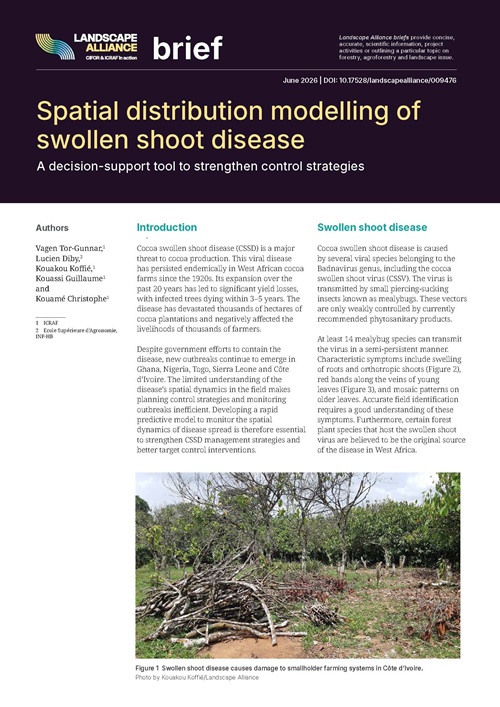
Cocoa swollen shoot disease (CSSD) is a major threat to cocoa production. This viral disease has persisted endemically in West African cocoa farms since the 1920s. Its expansion over the past 20 years has led to significant yield losses, with infected trees dying within 3–5 years. The disease has devastated thousands of hectares of cocoa plantations and negatively affected the livelihoods of thousands of farmers.
Despite government efforts to contain the disease, new outbreaks continue to emerge in Ghana, Nigeria, Togo, Sierra Leone and Côte d’Ivoire. The limited understanding of the disease’s spatial dynamics in the field makes planning control strategies and monitoring outbreaks inefficient. Developing a rapid predictive model to monitor the spatial dynamics of disease spread is therefore essential to strengthen CSSD management strategies and better target control interventions.
This work is licensed under CC-BY 4.0

Despite government efforts to contain the disease, new outbreaks continue to emerge in Ghana, Nigeria, Togo, Sierra Leone and Côte d’Ivoire. The limited understanding of the disease’s spatial dynamics in the field makes planning control strategies and monitoring outbreaks inefficient. Developing a rapid predictive model to monitor the spatial dynamics of disease spread is therefore essential to strengthen CSSD management strategies and better target control interventions.
This work is licensed under CC-BY 4.0
DOI:
https://doi.org/10.17528/landscapealliance/009476Altmetric score:
Dimensions Citation Count:
Export citation:
RIS (.ris)
Endnote (.ciw)
Publisher
CIFOR and ICRAF as Landscape Alliance: Bogor, Indonesia and Nairobi, Kenya
Publication year
2026
Authors
Vågen, T-G.; Diby, L.; Kouakou, K.; Kouassi, G.; Kouamé, C.
Language
English
Keywords
cocoa, disease control, disease transmission, monitoring, pest management, pests of plants, plant diseases, plant viruses, smallholders, spacial, swollen shoot virus
Geographic
Ghana, Nigeria, Togo, Sierra Leone, Côte d’Ivoire


